AI vs Traditional Cancer Detection: Which Is More Accurate and Why?
Introduction: A Critical Question in Modern Healthcare
Cancer detection has always been one of the most important—and challenging—areas of medicine. The earlier cancer is detected, the higher the chances of successful treatment. For decades, doctors have relied on traditional methods like imaging, biopsies, and clinical expertise to identify cancer.
These methods have saved millions of lives.
But today, a new player has entered the field: Artificial Intelligence (AI).
AI is not just another tool—it is transforming how we detect, analyze, and diagnose cancer. It raises an important question:
Is AI more accurate than traditional cancer detection methods?
And if so, why?
At Brainox AI, we believe that understanding this comparison is essential—not just for healthcare professionals, but for patients, innovators, and decision-makers shaping the future of medicine.
This article breaks down the differences between AI and traditional cancer detection in a simple, human way—helping you understand where each approach stands and how they work together.
Understanding Traditional Cancer Detection
Before comparing, let’s first understand what traditional cancer detection involves.
Common Methods Used
Traditional cancer detection relies on:
- Medical imaging (X-rays, CT scans, MRI)
- Mammography (for breast cancer)
- Biopsy and pathology analysis
- Physical examinations
- Blood tests and biomarkers
The Human Expertise Behind It
At the heart of traditional detection are highly trained professionals:
- Radiologists analyze imaging scans
- Pathologists examine tissue samples
- Oncologists interpret results and guide treatment
These experts use years of training, experience, and clinical judgment to make decisions.
Strengths of Traditional Methods
Traditional detection has several advantages:
1. Clinical Experience
Doctors bring years of real-world experience and intuition.
2. Contextual Understanding
They consider the patient’s full medical history, symptoms, and lifestyle.
3. Human Judgment
Doctors can interpret complex cases that don’t follow standard patterns.
4. Established Systems
Traditional methods are widely accepted and trusted.
Limitations of Traditional Detection
Despite its strengths, traditional detection has challenges:
1. Human Error
Even experts can miss subtle signs, especially under workload pressure.
2. Fatigue
Reviewing hundreds of scans daily can lead to oversight.
3. Variability
Different doctors may interpret the same scan differently.
4. Time Constraints
Analysis can take time, delaying diagnosis.
What Is AI-Based Cancer Detection?
AI-based cancer detection uses machine learning and deep learning algorithms to analyze medical data.
Instead of relying solely on human observation, AI systems:
- Learn from large datasets
- Identify patterns
- Detect abnormalities
How AI Works in Detection (Simple View)
AI systems are trained on:
- Thousands or millions of medical images
- Labeled data indicating cancer presence
Over time, they learn to:
- Recognize patterns
- Identify early signs
- Predict risks
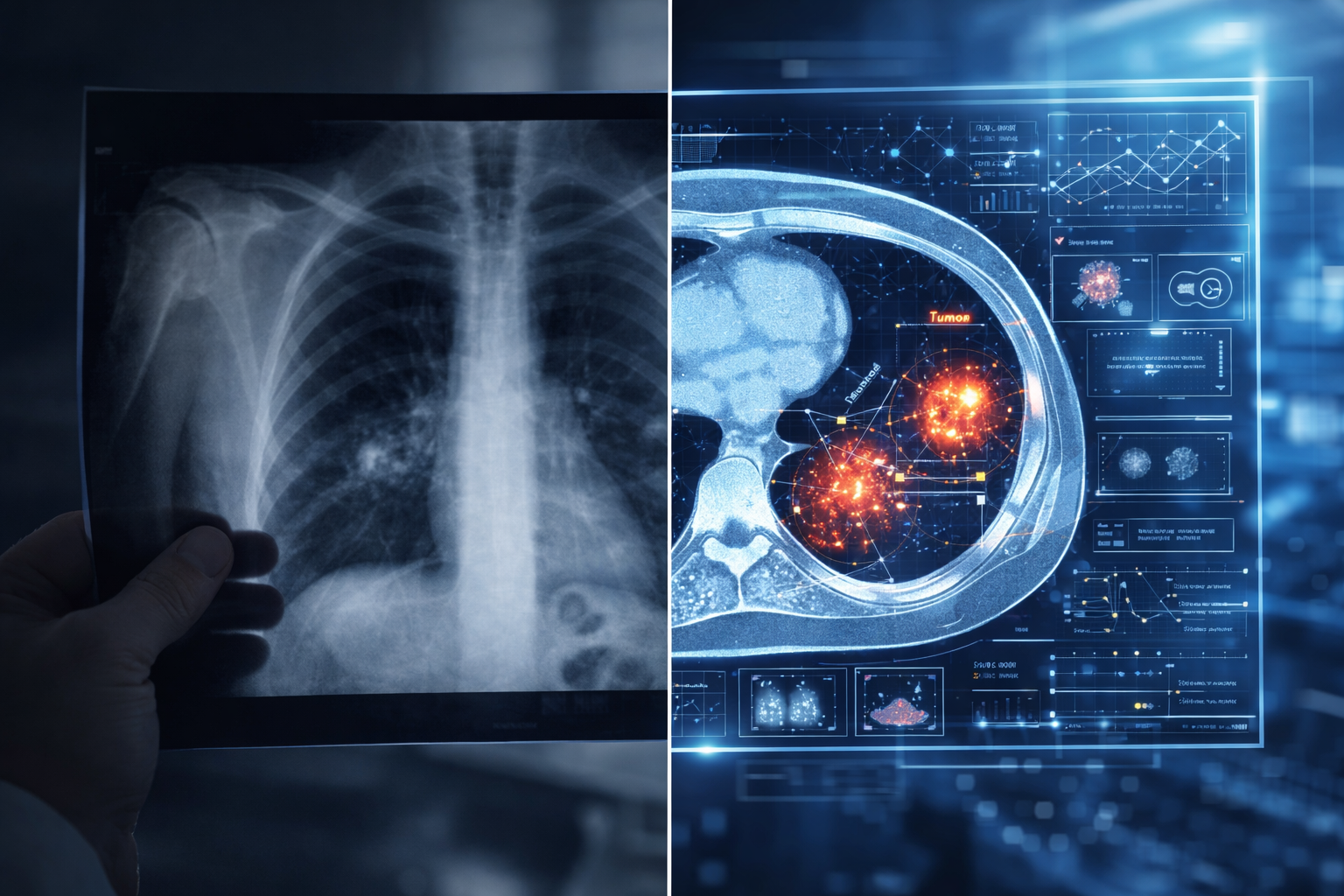
When a new scan is uploaded, AI:
- Analyzes it instantly
- Highlights suspicious areas
- Provides a probability score
The Core Comparison: AI vs Traditional Detection
Let’s compare both approaches across key factors.
1. Accuracy
Traditional Detection:
- Highly accurate in experienced hands
- Depends on doctor expertise
- May miss subtle early-stage signs
AI Detection:
- Detects micro-patterns invisible to humans
- Maintains consistent accuracy
- Improves with more data
👉 Verdict:
AI often shows higher accuracy in pattern detection, especially in early-stage cancer.
2. Speed
Traditional:
- Time-consuming analysis
- Delays possible in busy systems
AI:
- Processes scans in seconds
- Provides instant insights
👉 Verdict:
AI is significantly faster.
3. Consistency
Traditional:
- Results may vary between doctors
AI:
- Same input = same output every time
👉 Verdict:
AI offers unmatched consistency.
4. Scalability
Traditional:
- Limited by human workforce
AI:
- Can analyze thousands of cases simultaneously
👉 Verdict:
AI is far more scalable.
5. Human Understanding
Traditional:
- Strong contextual interpretation
- Emotional intelligence
- Patient communication
AI:
- Limited to data analysis
- No emotional or contextual understanding
👉 Verdict:
Traditional methods excel in human judgment.
Why AI Can Be More Accurate
The key question remains: Why does AI often outperform traditional methods in accuracy?
1. Ability to Analyze Massive Data
AI learns from millions of cases, far beyond what any human can experience in a lifetime.
2. Detection of Invisible Patterns
AI identifies:
- Tiny irregularities
- Subtle pixel-level changes
- Complex patterns
These may not be visible to the human eye.
3. No Fatigue
AI does not get tired, distracted, or overwhelmed.
4. Continuous Learning
AI improves over time as it processes more data.
5. Standardization
AI eliminates variability in interpretation.
Real-World Evidence: Where AI Outperforms
Breast Cancer Screening
AI has shown:
- Higher detection rates
- Reduced false positives
- Improved early-stage identification
Lung Cancer Detection
AI detects tiny nodules earlier than many radiologists.
Skin Cancer Diagnosis
AI models can match or exceed dermatologist-level accuracy in some cases.
But Is AI Perfect?
No.
AI has limitations.
1. Data Dependency
AI is only as good as the data it learns from.
2. Bias
If training data lacks diversity, results may be biased.
3. Lack of Context
AI does not understand:
- Patient emotions
- Medical history (unless integrated)
4. Black Box Problem
Some AI models are difficult to explain.
The Real Answer: It’s Not AI vs Traditional—It’s AI + Doctors
The most important insight is this:
The future is not about replacing traditional methods—it’s about enhancing them.
The Hybrid Approach
When AI and doctors work together:
- AI detects patterns
- Doctors interpret results
- Decisions become more accurate
This combination leads to:
- Better outcomes
- Faster diagnosis
- Higher confidence
A Practical Example
Imagine a radiologist reviewing a scan.
Without AI:
- Relies only on experience
- May miss subtle signs
With AI:
- AI highlights suspicious areas
- Radiologist reviews and confirms
This reduces errors and improves accuracy.
Impact on Patients
For patients, this transformation means:
- Earlier diagnosis
- Reduced waiting time
- More accurate results
- Less anxiety
Impact on Healthcare Systems
AI helps healthcare systems:
- Handle large patient volumes
- Reduce workload
- Improve efficiency
- Lower costs
The Future of Cancer Detection
Looking ahead, we can expect:
Predictive Detection
AI will identify cancer risk before symptoms appear.
Personalized Screening
Screening tailored to individual risk profiles.
Real-Time Monitoring
Continuous health tracking using wearable devices.
Global Access
AI will bring advanced diagnostics to remote areas.
Brainox AI’s Perspective
At Brainox AI, we believe that:
- AI should empower, not replace
- Technology should be practical
- Healthcare should be accessible
Our focus is on building solutions that:
- Improve accuracy
- Reduce delays
- Support doctors
- Enhance patient care
Ethical Responsibility
As AI grows, we must ensure:
- Data privacy
- Transparency
- Fairness
- Accountability
Responsible AI is essential.
Conclusion: Accuracy Redefined
So, which is more accurate—AI or traditional cancer detection?
The answer is nuanced.
AI often provides:
- Higher pattern detection accuracy
- Faster analysis
- Consistent results
Traditional methods provide:
- Context
- judgment
- human understanding
The Final Verdict
AI is more accurate in data-driven detection.
Doctors are essential for interpretation and decision-making.
Together, they create the most powerful diagnostic system ever built.
Final Thought
We are not choosing between humans and machines.
We are building a future where both work together.
A future where:
- Cancer is detected earlier
- Treatment is more effective
- Lives are saved
At Brainox AI, we are proud to be part of this transformation.
Because accuracy is not just about technology.
It’s about giving people a better chance at life.
