
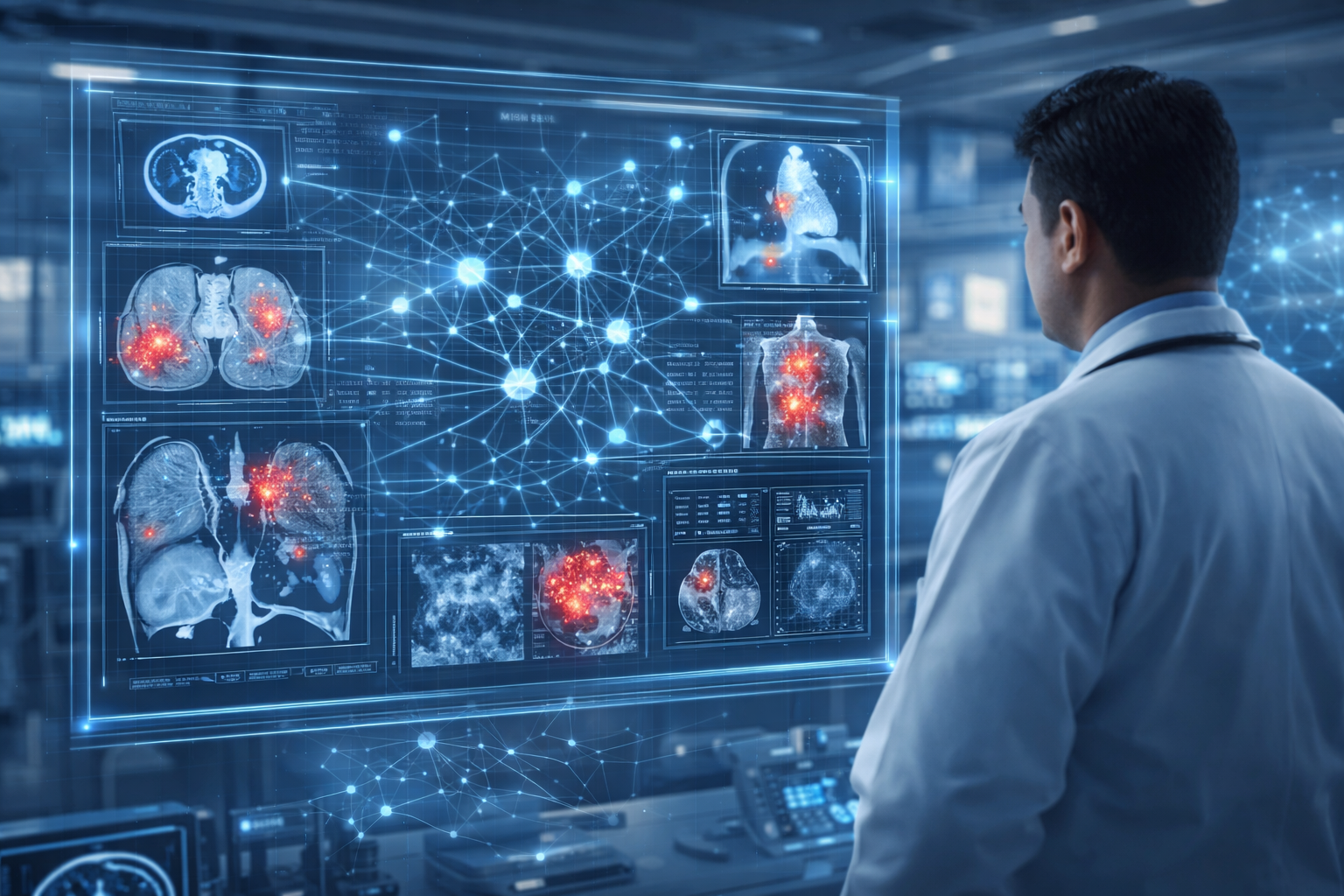
Inside AI-Powered Cancer Screening: How Machines Learn to Detect Disease
Introduction: A Quiet Revolution in Healthcare
In hospitals and diagnostic centers around the world, something remarkable is happening—often unnoticed by patients, yet profoundly changing their outcomes.
Behind the scenes, machines are learning.
They are learning to recognize patterns in medical images, identify subtle signs of disease, and assist doctors in making faster, more accurate decisions. This is not science fiction. This is Artificial Intelligence (AI), and it is reshaping how we detect one of the most complex diseases known to humanity: cancer.
For decades, cancer screening has relied heavily on human expertise. Radiologists, pathologists, and clinicians have spent years mastering their craft—analyzing scans, studying tissues, and interpreting results. But as powerful as human expertise is, it has limitations.
AI is stepping in not to replace that expertise, but to amplify it.
At Brainox AI, we are deeply invested in understanding and building systems that bridge advanced technology with real-world healthcare challenges. In this article, we take you inside AI-powered cancer screening—explaining not just what it does, but how it learns to detect disease in ways that are transforming early diagnosis.
Why Cancer Screening Needed Innovation
Before diving into how AI works, it’s important to understand why innovation in cancer screening became necessary.
1. Increasing Volume of Medical Data
Modern healthcare generates enormous amounts of data:
- Millions of medical images daily
- Complex patient histories
- Genetic information
No human can process all of this efficiently without assistance.
2. Subtle Early Signs
Early-stage cancer often presents with extremely subtle changes:
- Tiny nodules
- Slight tissue irregularities
- Minor density differences
These can be easy to miss, even for experienced professionals.
3. Time Pressure on Doctors
Radiologists may review hundreds of scans per day. Fatigue and workload can impact accuracy.
4. Variability in Interpretation
Two experts may interpret the same scan differently. This inconsistency can affect diagnosis and treatment decisions.
These challenges created a need for tools that are:
- Faster
- More consistent
- Highly precise
This is where AI enters the picture.
What Does “AI-Powered Cancer Screening” Really Mean?
AI-powered cancer screening refers to the use of intelligent algorithms to analyze medical data—especially images—to detect signs of cancer.
These systems are designed to:
- Identify abnormalities
- Highlight suspicious areas
- Assist doctors in decision-making
But the most fascinating part is not what AI does—it’s how it learns to do it.
How Machines Learn: The Foundation of AI
To understand AI in cancer screening, we need to understand how machines learn.
Learning Like a Human—But at Scale
Imagine teaching a child to recognize a cat. You show them many pictures:
- “This is a cat.”
- “This is not a cat.”
Over time, the child learns to identify patterns.
AI works in a similar way—but instead of dozens of examples, it learns from millions.
Step-by-Step: How AI Learns to Detect Cancer
Let’s break this down into simple steps.
Step 1: Data Collection – The Learning Material
AI systems are trained using large datasets that include:
- X-rays
- CT scans
- MRI images
- Mammograms
- Pathology slides
Each image is labeled by experts:
- Cancer present
- Cancer absent
This labeled data is the foundation of learning.
Step 2: Training the Model – Teaching the Machine
AI uses a technique called deep learning, which is inspired by the human brain.
It involves neural networks—layers of algorithms that process information.
During training:
- The AI analyzes images
- Makes predictions
- Compares them with actual labels
- Adjusts itself to improve accuracy
This process is repeated thousands of times.
Step 3: Pattern Recognition – Seeing the Invisible
Over time, the AI begins to recognize patterns such as:
- Irregular shapes
- Abnormal textures
- Subtle density changes
These patterns may be too small or complex for humans to detect consistently.
Step 4: Validation – Testing the System
Before being used in real-world settings, AI models are tested on new data.
This ensures:
- Accuracy
- Reliability
- Safety
Step 5: Deployment – Assisting Doctors
Once validated, AI systems are integrated into clinical workflows.
When a new scan is uploaded:
- The AI analyzes it instantly
- Highlights areas of concern
- Provides a confidence score
Doctors then use this information to make informed decisions.
Types of AI Used in Cancer Screening
1. Image-Based AI
This is the most common type.
Used for:
- Radiology scans
- Mammography
- CT imaging
2. Pathology AI
Analyzes tissue samples:
- Detects abnormal cells
- Grades tumors
3. Predictive AI
Uses patient data to predict:
- Cancer risk
- Disease progression
4. Genomic AI
Analyzes genetic data to identify:
- Mutations
- Personalized treatment options
Real-World Applications of AI in Cancer Screening
AI is already making a significant impact.
Breast Cancer Screening
AI improves mammogram analysis by:
- Detecting early-stage tumors
- Reducing false positives
- Supporting radiologists
Lung Cancer Detection
AI identifies tiny lung nodules in CT scans.
This is crucial because lung cancer is often detected late.
Skin Cancer Detection
AI can analyze images from smartphones to detect skin cancer.
This increases accessibility, especially in remote areas.
Prostate and Colorectal Cancer
AI assists in analyzing scans and biopsy samples for these cancers.
Why AI Is So Effective
1. Speed
AI can process images in seconds.
2. Scale
It can analyze thousands of cases simultaneously.
3. Precision
AI detects patterns invisible to the human eye.
4. Consistency
It delivers the same level of accuracy every time.
AI as a Second Pair of Eyes
One of the best ways to understand AI is to think of it as a second pair of eyes.
It does not replace the doctor—it supports them.
Benefits:
- Reduces missed diagnoses
- Increases confidence
- Improves decision-making
Challenges in AI-Powered Screening
Despite its advantages, AI faces challenges.
Data Quality Issues
AI is only as good as the data it learns from.
Bias in Training Data
If training data lacks diversity, results may not generalize well.
Integration Challenges
Hospitals need infrastructure to use AI effectively.
Trust and Adoption
Doctors must trust AI recommendations.
The Ethical Side of AI in Healthcare
AI raises important questions:
- Who owns patient data?
- How is privacy protected?
- Can AI decisions be explained?
Responsible AI development is essential.
The Future: Where AI Is Headed
The future of AI in cancer screening is incredibly promising.
Early Prediction
AI will identify cancer risk before symptoms appear.
Real-Time Detection
Wearables may detect early signs continuously.
Personalized Screening
Screening will be tailored to individual risk profiles.
Global Accessibility
AI will bring advanced diagnostics to underserved regions.
Brainox AI’s Approach
At Brainox AI, our focus is on building systems that are:
- Reliable
- Scalable
- Easy to use
- Clinically relevant
We aim to:
- Empower doctors
- Reduce diagnostic delays
- Improve early detection outcomes
Our vision is to turn complex AI technology into practical healthcare solutions.
Human Impact: What This Means for Patients
At the end of the day, AI is not just about machines.
It’s about people.
It means:
- Earlier diagnoses
- Better treatment outcomes
- Less anxiety during waiting periods
- More lives saved
Conclusion: Understanding the Intelligence Behind the Machine
AI-powered cancer screening is not magic—it is the result of intelligent systems learning from vast amounts of data, continuously improving, and working alongside human experts.
By understanding how machines learn, we can better appreciate their role in healthcare.
This is not about replacing doctors.
It is about creating a future where:
- Detection is faster
- Diagnosis is more accurate
- Outcomes are better
At Brainox AI, we believe this is just the beginning.
Final Thought
The real power of AI lies not in the technology itself, but in how it is used.
When combined with human expertise, compassion, and purpose, AI becomes more than a tool.
It becomes a force for better healthcare.
